Free shipping in uae!

Phone Case vs Phone Cover — What's the Difference? | PhoneCase.ae
Not sure whether to buy a phone case or cover? We break down the difference, pros & cons, and which one suits your phone best.
6/3/20264 min read
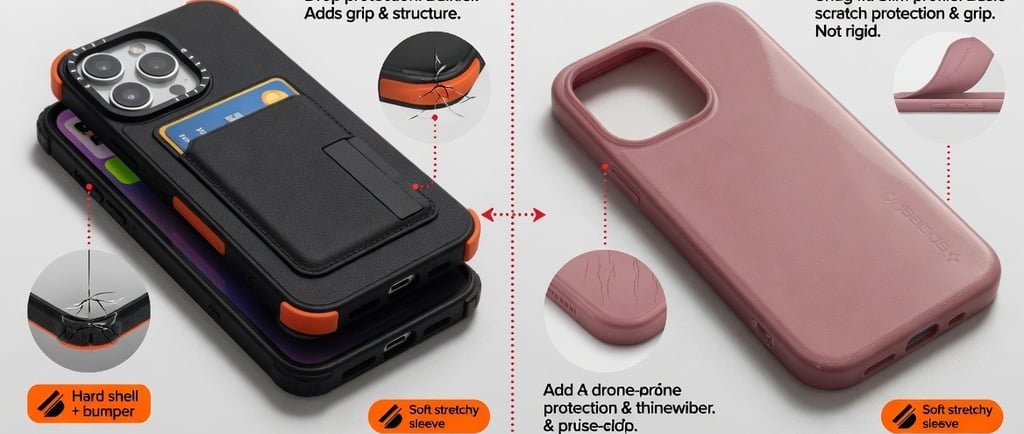
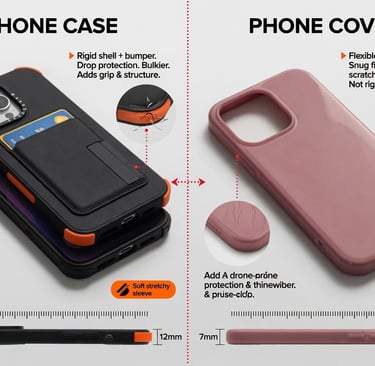
If you've ever searched for phone protection online, you've probably seen both terms used — "phone case" and "phone cover" — sometimes for the exact same product. So what's actually the difference? And does it even matter which one you buy?
The short answer: the terms are often used interchangeably, but there is a practical distinction. Understanding it helps you choose the right protection for how you use your phone.
What is a phone case?
A phone case is a rigid or semi-rigid accessory that wraps around the back and sides of your phone. It typically snaps or slides onto the device and stays in place until you remove it.
Phone cases are designed to protect the back and sides from scratches, drops, and everyday wear. Most cases leave the screen fully exposed — protection for the front glass usually comes from a separate screen protector.
Common types of phone cases:
Clear TPU cases
Silicone cases
Hard polycarbonate cases
Rugged dual-layer cases
MagSafe-compatible cases (for iPhone)
Kickstand cases
The defining feature of a phone case is that it covers three sides: left, right, and back. The screen remains open and accessible at all times.
What is a phone cover?
A phone cover — also called a flip cover or folio cover — includes a front flap that folds over the screen. Think of it like a book cover for your phone. When you're not using your phone, the front flap protects the screen. When you want to use it, you flip it open.
Phone covers typically attach to the back of the phone (either via a hard shell or adhesive) and have a front panel made of leather, faux leather, or hard plastic that folds over the display.
Some covers include card slots, a cash pocket, or a mirror on the inside of the front flap.
Common types of phone covers:
Leather flip covers
Wallet covers with card slots
Magnetic folio covers
Book-style covers
LED view covers (show notifications through a small window)
The defining feature of a phone cover is that it protects the screen as well as the back — but requires you to flip it open every time you use your phone.
Phone case vs phone cover — key differences
Which one is better?
Neither is universally better — it depends entirely on how you use your phone.
Choose a phone case if:
You use your phone constantly. If you're checking messages, taking photos, scrolling, or making calls throughout the day, a flip cover adds a small but real friction every time you unlock. A case lets you access your phone instantly.
You take a lot of photos. Cases don't interfere with the camera at all. Covers can be awkward to manage when shooting — you're either holding the flap open or folding it behind the phone, which adds bulk in your hand.
You want maximum style variety. Phone cases come in thousands of designs — clear, printed, textured, branded, minimalist. Covers are mostly limited to leather-look finishes and conservative styles.
You already use a screen protector. If you have a quality tempered glass screen protector installed, your screen is already well protected. A case is all you need for complete coverage.
Choose a phone cover if:
You want one accessory that does everything. A good wallet cover replaces your phone case, screen protector, and slim wallet in one. If you're someone who prefers going out with just a phone, a cover with card slots is genuinely practical.
You work in a professional environment. Leather folio covers look polished and formal — more appropriate in business meetings than a bright silicone case. Many professionals in Dubai and Abu Dhabi prefer the look of a slim leather cover.
Your screen is your biggest concern. If you've cracked your screen before and you're determined not to repeat it, a cover protects the display even when the phone is sitting face-up on a desk or sliding around in a bag.
You don't mind the extra step. If you're not a heavy phone user and the flip-open motion doesn't bother you, a cover's all-round protection is genuinely better than a case alone.
What about "phone case cover"?
You'll often see the term "phone case cover" used online — this is simply people combining both words to describe any type of protective accessory for a phone. It doesn't refer to a specific product type. When you see it in a search result or product listing, look at the photos to understand what you're actually getting.
Similarly, "mobile case" and "mobile casing" mean the same thing as phone case — just different regional phrasing. In the UAE, all three terms are widely used.
Can you use both?
Technically yes — some people put a slim silicone case on their phone and then use a separate magnetic folio that attaches via a plate stuck to the back of the case. But for most people this adds unnecessary bulk. Pick one or the other.
The exception: if you have a phone with a large, fragile camera module (like the iPhone 15 Pro Max or Samsung Galaxy S24 Ultra), a case with a raised camera ring plus a separate screen protector is usually the smartest combination — better protection than any cover, with full usability.
Final thoughts
Phone case or phone cover — the right choice depends on your lifestyle, not which term sounds better.
If you're active, take photos often, and want quick access to your phone, go with a case. If you want all-in-one protection and card storage, and don't mind the flip, a cover makes sense.
Either way, buy for your actual phone model and check that the cutouts, buttons, and camera opening match exactly. A poor fit defeats the whole purpose.
[Browse phone cases at PhoneCase.ae →]
Published by PhoneCase.ae — UAE's dedicated phone case store. Fast delivery across Dubai, Abu Dhabi, Sharjah, and all emirates.
Premium phone case store serving the UAE since 2020. Same-day delivery in Dubai & Abu Dhabi. Over 350 designs for all major phone models.
Contact
Newsletter
info@phonecase.com
© 2026. All rights reserved.
Shop
iPhone Cases
Samsung Cases
Google Pixel
Custom Cases
New Arrivals
Sale
Support
Track Your Order
Returns & Exchanges
FAQ